Virtual try-on for eyewear: from experiment to sales tool
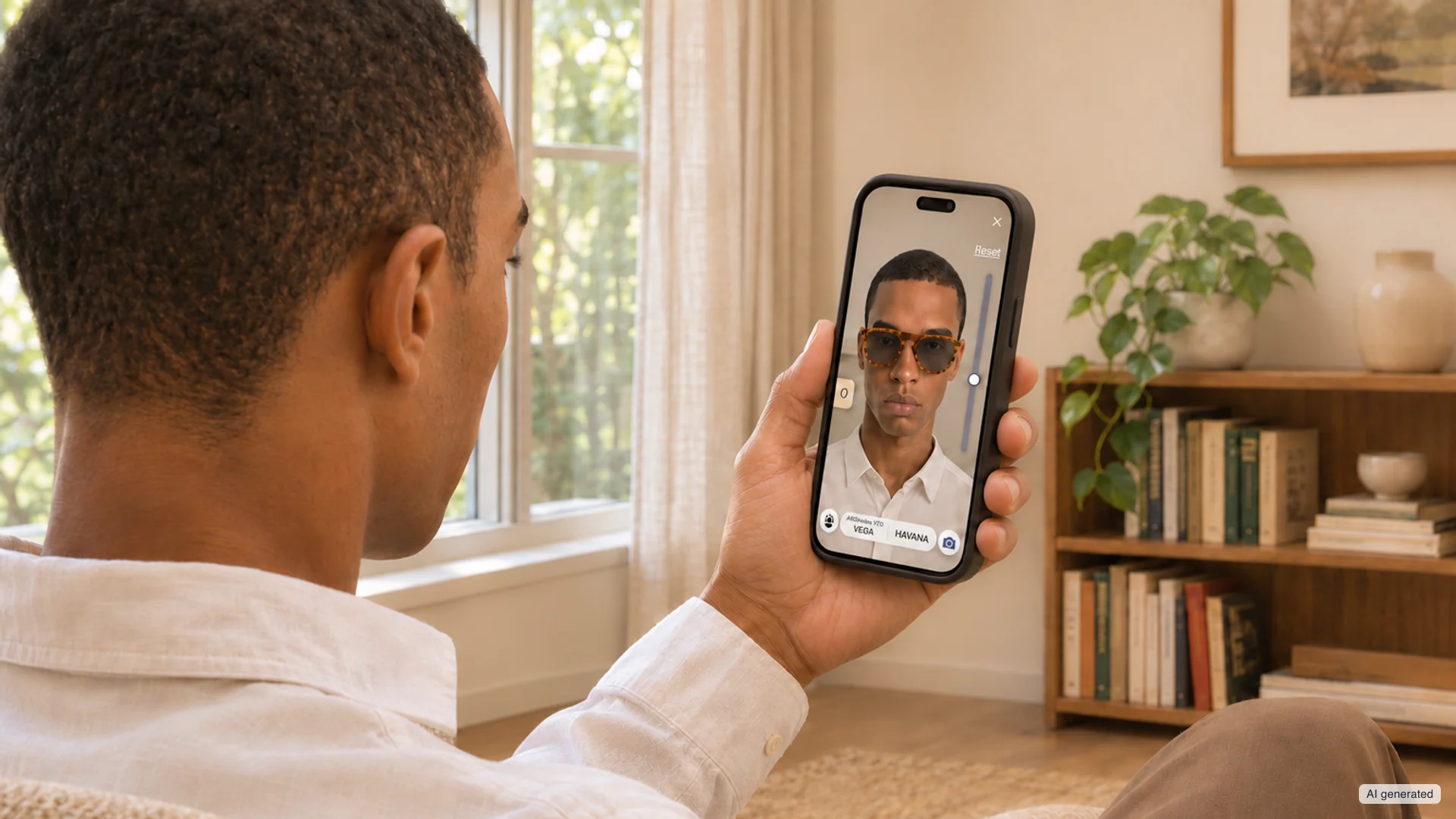
Virtual try-on (VTO) for eyewear is no longer the add-on “gimmick” that intrigued and entertained people as they shopped. It began life as a marketing initiative in the wake of social media filters, riding a wave of visual effects (some of them far from convincing) set off by the arrival of augmented reality (AR) on our phones. Today, when it comes from a professional provider, virtual try-on is a reliable feature that supports selling online and in shops. Three factors in particular bear this out: the technology behind it now rests on established standards; large online shops, among others, have extended it to ever larger catalogues; and the companies that used to post frames to customers’ homes to try on have closed that service. Virtual try-on now spares customers the whole “order, try at home, send back if it doesn’t suit” routine. Yet while VTO is becoming a familiar sight on product pages, its adoption is not linear: eyewear companies, manufacturers above all, are moving cautiously, each at its own pace.
Is virtual try-on for eyewear reliable today?
Today’s professional virtual try-on solutions offer exceptional realism and have overcome the technology’s biggest hurdles, such as showing the glasses on the face at true scale, keeping them steady as the wearer moves and, more generally, making them match the real product. A few years ago it was hard to achieve all three at once, except in a demo.
The clearest signals come from the people who sell eyewear every day.
Warby Parker, the US retailer that started out online, built its business on home try-on: a handful of frames posted to customers to try on and send back. In August 2025 it announced it was ending the service, putting the decision down to its 300 or so shops and its digital tools, virtual try-on among them.1 In its 2025 annual report it notes that many customers start their journey online, with virtual try-on.2
EssilorLuxottica, the group behind Ray-Ban and Oakley, offers it on its brands’ websites: its annual regulatory filing names Ray-Ban, Costa and EyeBuyDirect.3 It is also taking it into shops: there were more than 6,000 virtual try-on stations in optical practices in 20234 and more than 8,500 by the end of 2025.3
Walmart launched virtual try-on for prescription glasses in January 2024, with more than 750 frames.5 In May 2025 it announced it was extending it to more than 1,700.6
In the prospectus for its 2025 stock market listing, the Indian eyewear chain Lenskart reports 38.59 million virtual try-ons in a single year, across its apps and website.7
A long-standing service closed, a catalogue doubled, millions of try-ons in a year: these are not experiments. They are part of how these companies sell.
Reliable does not mean uniform, though: quality depends on the 3D models, the engine that displays them and the devices supported.
What has changed in virtual try-on technology?
Almost everything that matters: virtual try-on is now stable, runs in the browser, shows the frame at true scale and renders materials better.
In the early years it asked more of the customer. In 2019 Warby Parker’s virtual try-on worked only on the iPhone X and later models, because it relied on the depth camera, the sensor that measures how far each point of the face is from the phone.8 Other apps asked users to hold a card against their forehead so that the camera could take measurements.9
Since then, progress has come on six fronts.
Stability. In 2019 Google researchers showed how to map the face in three dimensions, with 468 points, from an ordinary camera image and in real time on a phone.10 Since 2023 a more complete version has been available to everyone, in the browser too.11
More channels. Between 2019 and 2022 two standards made the browser fit for the job: WebAssembly, for heavy computation,12 and WebGL 2.0, for 3D graphics.13 At the end of 2025 the faster WebGPU reached the major browsers too.14 Virtual try-on can now sit on the product page, with no app to install.
True measurements. In 2020 Google showed that the width of the iris, which is almost the same in everyone, can be used to work out the distance between face and camera without special sensors.15 In a 2024 study, pupillary distance measured with an app differed on average by 0.6 millimetres from a professional instrument’s reading; the authors consider the app suitable for an initial check.16
Realism. Since 2021 the 3D model standard has also been able to describe transparent materials, which acetates and lenses need.17
Large catalogues. In August 2022 the glTF 2.0 format, used to transmit and load 3D models, became the international standard ISO/IEC 12113:2022.18 A frame’s 3D model is no longer tied to a single piece of software.
3D model production. In 2025 the Khronos Group, which maintains the glTF format, updated its guidelines for creating 3D product models ready for online retail.19 This is the least visible part of the work, and the most time-consuming.
Who is already using virtual try-on?
Beauty, fashion and footwear have used it for years. In eyewear, online shops and chains led the way; brands and manufacturers are following.
Outside eyewear the path has been the same: first an experiment, then a permanent feature. In 2019 Nike added a feature to its app that measures feet with the phone camera.20 In 2020 the US beauty chain Ulta Beauty put QR codes on its shelves that open a virtual make-up try-on;21 its annual report published in March 2026 still lists it among the experiences driving growth in its online sales.22 In 2022 Walmart made it available for more than 270,000 clothing items, using the customer’s own photo.23 In 2023 Tommy Hilfiger brought it to the mirrors of three European shops.24 In 2025 Amazon closed its home try-on service for clothing, partly because of the growing use of virtual try-on,25 and Google began letting people try clothes on a photo of themselves in Search.26
On Instagram and Facebook, meanwhile, the age of effects just for fun is over. In January 2025 Meta removed the augmented reality effects created by brands and creators,27 and at the end of 2025 it shifted part of its investment from the metaverse to AI glasses.28 The signal is clear: AR built to impress is giving way to AR built to be useful. When people are choosing something to buy, fun is not enough: an experience that is too playful actually raises doubts and undermines trust.29 Today virtual try-on is judged on realism and on how true it is to the product: that is what customers ask for, and what a professional solution must guarantee.
In eyewear, these are some of the documented milestones.
- 2019. The eyewear brand Police (De Rigo group) launches virtual try-on for all its collections on its website.30 Warby Parker adds it to its app.8 At MIDO in Milan, Luxottica presents an in-store tool that lets customers virtually wear every model in the catalogue.31
- 2020. The manufacturer Thema launches an app that lets customers in shops see frames on their own face.32 Silhouette adds virtual try-on to its website.33
- 2021. Silhouette links it to a digital showroom for retailers.34
- 2022. Modern Optical, a US manufacturer, offers it to independent optical retailers, with more than 600 models.35
- 2023. EssilorLuxottica makes images created from 3D models its “new standard” for presenting products.36
- 2024. Walmart launches virtual try-on for prescription glasses.5 The Blackfin brand introduces a true-scale virtual try-on tool on its website.37 At MIDO, Safilo devotes an area of its stand to virtual try-on built with ARShades.38
- 2025. At MIDO again, Safilo brings virtual try-on to a large screen that uses a live camera feed of the people in front of the stand, including groups and people up to 8 metres away, and shows the glasses on their faces.39 Warby Parker adds AI recommendations to its app40 and announces the end of home try-on.1
- 2026. ClearVision, a US manufacturer, launches a virtual try-on tool for children’s glasses that shops can add to their own websites.41 In its online shop, Meta lets customers virtually try on Ray-Ban Meta and Oakley Meta glasses.42
Where do eyewear companies stand on virtual try-on?
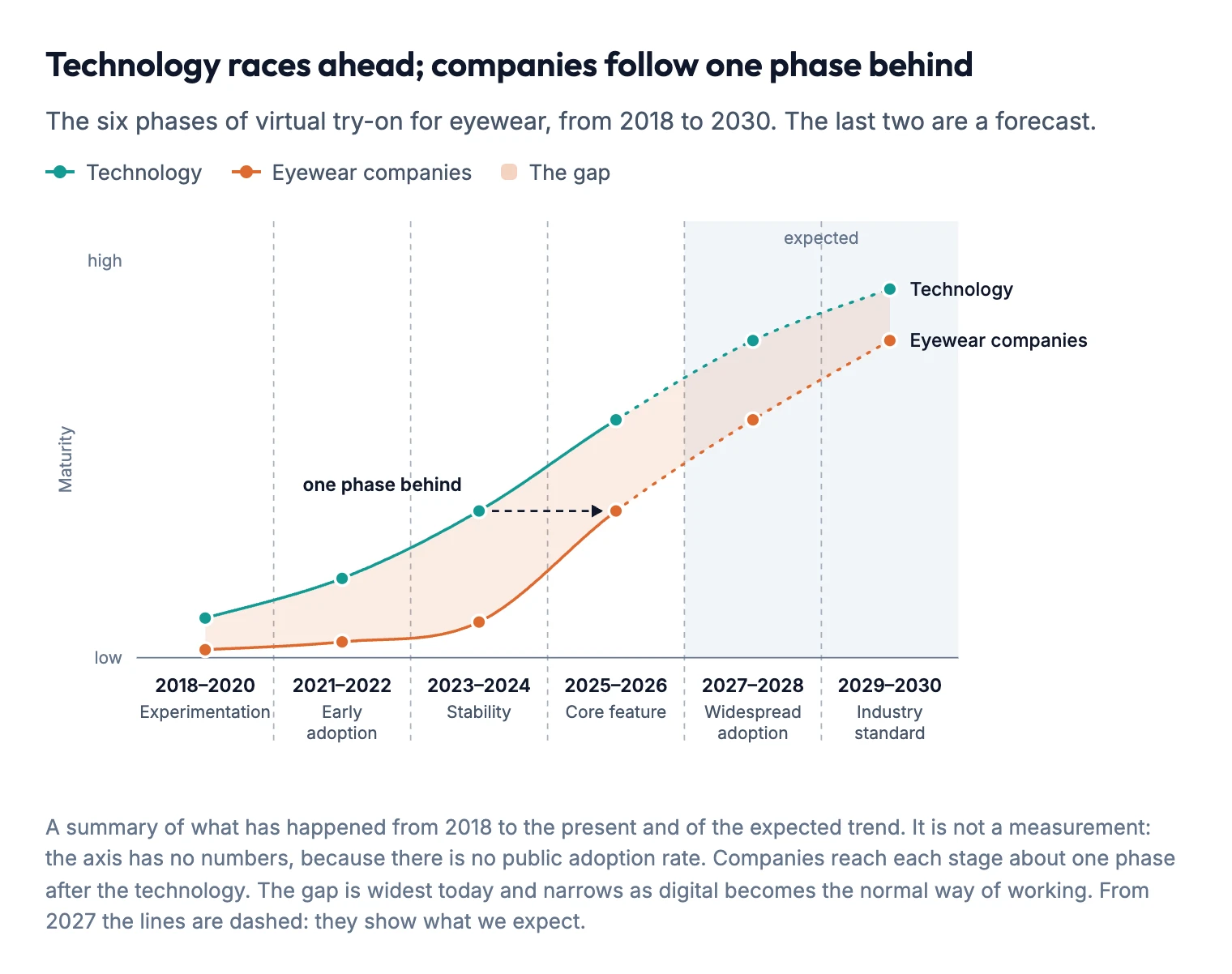
Adoption of virtual try-on is growing worldwide. It is following the progress of the technology and narrowing the gap between the tools available and those actually found on product pages. No one publishes an adoption rate for brands and manufacturers, but the order of events is clear: online shops and chains were the early adopters, and brands and manufacturers are following.
The technology, meanwhile, has come a long way: stability, more channels, true measurements, realism, large catalogues and better-produced 3D models.
The results are already showing. A study of 160,400 customers of a cosmetics retailer found higher sales with virtual try-on, especially for higher-value products and new customers:43 conditions typical of eyewear sales. Virtual try-on helps with returns too, on one condition: it must show the product at true scale. When it does not, it creates unrealistic expectations,44 and a disappointed customer blames the seller.45 That is the difference between an effect that intrigues and a professional tool. And the most convincing place to measure it is still your own online shop.
That is why many companies waited for the technology to mature. Meanwhile, they had their own online sales to put in order, and these were not always up to scratch. The most innovative companies moved first: those mentioned in the earlier sections.
Today, the point has shifted. Virtual try-on is becoming a normal part of the product page, alongside product shots and on-model photos. For Lenskart it is one of the two most used features in its app.7 Shoppers are starting to expect it. In our view, this counts for at least as much in the decision as conversions and returns.
The chart summarises what has happened from 2018 to the present and the expected trend up to 2030. It is not a measurement: the axis has no numbers, because there is no public adoption rate.
| Years | Phase | Technology | Eyewear companies |
|---|---|---|---|
| 2018–2020 | Experimentation | Proofs of concept | Trade fair demos, internal trials |
| 2021–2022 | Early adoption | Apps, first web versions | Limited launches on a few models |
| 2023–2024 | Stability | Stable feature across multiple devices | Use on specific collections or markets |
| 2025–2026 | Core feature | Built into online shopping journeys | Strategy across all channels |
| 2027–2028 | Widespread adoption (expected) | Still maturing | Virtual try-on across most of the catalogue |
| 2029–2030 | Industry standard (expected) | Part of the product’s digital workflow, from design to sale | 3D models created through a standard workflow, alongside the collection |
The technology arrives first, and eyewear companies follow about one phase behind. It is a systemic lag, and an understandable one. It narrows once digital becomes the normal way of working: that is our expectation for 2029–2030.
Why is virtual try-on hard to scale?
Because a demo involves one pair of glasses, one phone and one person. A service involves thousands of frames, every kind of device and many people across the business. The difficulty lies on both sides.
For those who build it. Virtual try-on has to deliver the same result on phones at every price point, with different cameras, browsers and lighting. It has to redraw the frame dozens of times a second, on a page that loads quickly, and render difficult materials well, such as transparent acetates and lenses with reflections.
For those who adopt it. A collection is made up of hundreds or thousands of frames, each in several colours. Every variant is a 3D model to be produced, checked and approved. It cannot be generated automatically from a photo: a frame has thin parts, few surface features to recognise and components that hide one another.46 Even Walmart built up its catalogue gradually.6 Then virtual try-on has to be connected to the systems and websites of every brand and every market. And every season, the digital catalogue has to stay in step with the physical one.
Providers now offer many ready-made tools. It still takes time, however, because virtual try-on requires the manufacturer to adopt a standard workflow for creating 3D models: the same rules for every frame, every colour, every season. Building that workflow takes longer than installing the technology.
What about artificial intelligence? Systems that generate a 3D model from one or a few photos already exist, and the biggest technology groups are working on them: since 2025, Meta, Microsoft, Google, Tencent, Alibaba and Apple have all unveiled such systems. The progress is real but the results are still immature, as the developers themselves say. Meta, for example, writes that its system still captures little detail in complex objects and makes more mistakes with transparency and small objects.47 In some cases the result is not even a complete model: for products people can buy, Google generates a video that circles the object.48 And an independent test by Italy’s Fondazione Bruno Kessler research institute judges these systems useful for approximate visualisation, but not yet accurate enough to measure an object.49 A pair of glasses, with its thin temples, transparent lenses, polished metal and millimetre-precise dimensions, brings together exactly the cases these systems find hardest. It is a field attracting heavy investment, but it is not mature yet: virtual try-on that is faithful to the product still needs a carefully built 3D model. ARShades is also working on creating 3D models from images, following the same rule as today’s models: the model must match the real glasses.
Then there is the nature of the industry itself. Eyewear struggles to change the way it works, even though it sits at the centre of many changes at once: smart glasses,50 virtual try-on, 3D design and 3D printing, which until a few years ago was used almost exclusively for prototyping.51 Manufacturers say so themselves. In January 2026 Nicola Belli, vice-president of ANFAO, the association of Italian eyewear manufacturers, put it this way: “We need to equip ourselves with digital technologies that cut across every stage.”52
It is an understandable lag: the work takes a long time, and little of it is visible from outside.
Why is virtual try-on crucial for selling eyewear online?
Because there is no mirror online, and virtual try-on takes its place. Online is where eyewear sales are growing, and that is where virtual try-on makes the difference.
The growth shows in the figures. In 2025 EssilorLuxottica’s online sales grew by almost 20%, led by Ray-Ban.com.53 In India, Lenskart earns almost half its revenue from customers who used its digital channels in the 90 days before buying.7
On the product page, virtual try-on does the mirror’s job: customers see the frame on their own face, at true scale, and buy with more confidence. That is why it is becoming a normal part of the page, like product shots and on-model photos. Selling online without virtual try-on means asking customers to buy blind.
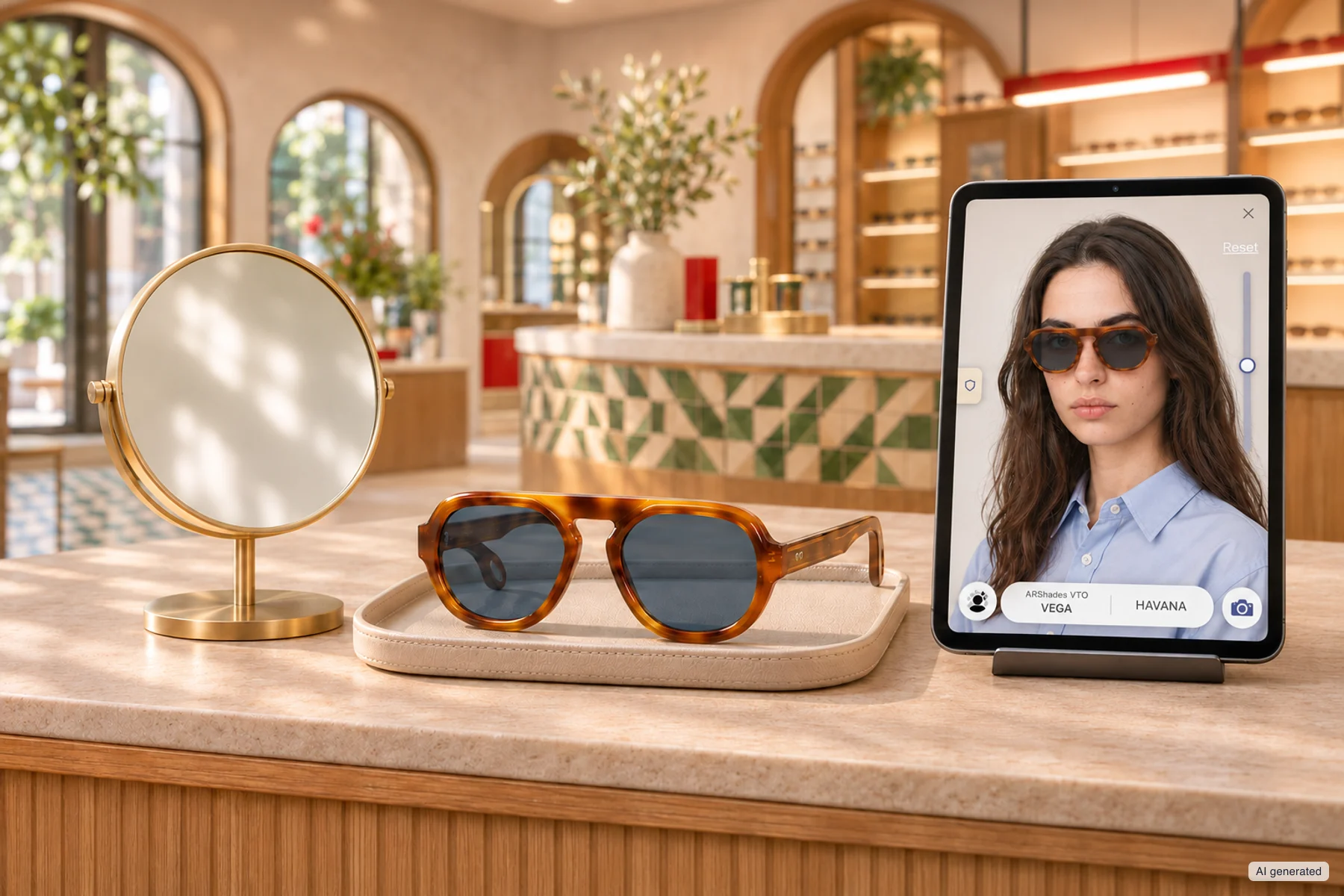
The same virtual try-on can also be used in shops, on a screen or tablet: customers browse the whole catalogue by themselves, including models and colours that are not on display. EssilorLuxottica has more than 8,500 virtual try-on stations in optical practices.3 But its main place is still the product page.
What can virtual try-on do that a physical try-on cannot?
It can show an entire collection on the same face in a few seconds, and let people who need their glasses to see try on a new frame.
Virtual try-on was created to imitate the shop mirror: one frame at a time, as faithfully as possible. That goal has largely been achieved. But a digital try-on is not bound by the limits of a physical one.
Comparing. People choosing a frame often do not know which shape or colour suits them, and at the mirror they can only compare, from memory, the few frames they have tried on. Virtual try-on puts dozens of models side by side on the same face in a few seconds, and the choice quickly narrows to the ones they like best.
Trying on with your glasses on. People who wear prescription glasses struggle to see themselves in the mirror without them. Virtual try-on can start from a photo of the face, which they then look at with their own glasses on. Or it can remove the glasses they are wearing from the video and show the new frame in their place.
Choosing at leisure, from the whole catalogue. Every model and every colour is available, even when the physical frame is not. And the preview can be sent to a family member or friend for a second opinion.
All this may be enough to replace an in-person try-on, or it can pave the way for one.
This is where ARShades focuses. Its Virtual Try-On runs in the browser, with no app to install. With VTO Explorer, people take a single photo of themselves and see the entire catalogue on their own face. With Glasses Removal, on recent browsers and devices, the Virtual Try-On removes the prescription glasses a person is wearing from the video and shows the new frame live. Catalogues and experiences are managed in ARShades Studio.
Two limitations remain, and it is only fair to name them. A digital preview cannot convey the feel of the material, the weight or the fit: for those who want it, trying the frame on in person remains the final step. And the effect on sales has to be measured case by case: we have found no independent studies on eyewear. That is the subject of our article “Designing a Virtual Try-On pilot that supports a decision”.
The useful question today is no longer whether virtual try-on works. It is how to build it into the way you sell: on which products, through which channels and at what level of quality.
Frequently asked questions
Why is virtual try-on important for selling eyewear online?
Because there is no mirror online, and shoppers increasingly expect virtual try-on: it is becoming a normal part of the product page, like product shots and on-model photos. For Lenskart it is already one of the two most used features in its app. The 3D model behind it is also worth more than the try-on alone: with the ARShades viewing engine, the same model provides a 360-degree view and photorealistic renders, still and animated, directly in the browser. That means savings on photo shoots and renders commissioned separately. For manufacturers, offering 3D models and virtual try-on can also carry weight when a retailer chooses its suppliers. We discuss this in our article “From Feature to Infrastructure: Rethinking AR for Digital Eyewear”.
Does virtual try-on increase online sales?
Research says it does, especially for higher-value products and new customers: a study of 160,400 customers of a cosmetics retailer found that sales rose with virtual try-on. There are no published independent studies on eyewear yet, so the most convincing approach is to measure it in your own online shop, with a pilot project.
Does virtual try-on reduce returns?
Yes, when it shows the frame at true scale. A try-on that gets the proportions wrong creates unrealistic expectations: the customer is disappointed, sends the product back and blames the seller. That is why the quality of the 3D model and true scale matter.
Does virtual try-on for glasses work without installing an app?
Yes. Virtual try-on for eyewear can now run in the browser on a phone or computer, within the product page. Web standards that became widely available between 2019 and 2025, such as WebAssembly, WebGL 2.0 and WebGPU, make this possible.
What do you need to add virtual try-on to your website?
You need an accurate 3D model of every frame in every colour, and a service that displays it on the product page, in the browser, on any phone. The most time-consuming part is producing the 3D models and keeping them up to date, collection after collection.
Can AI create a 3D model of a pair of glasses from a photo?
Not yet with the accuracy required. Meta, Microsoft, Google and others have unveiled systems that generate 3D models from a few photos, but for glasses, with their thin parts, transparent lenses and millimetre-precise dimensions, the results are still approximate. A faithful try-on needs a carefully built 3D model. ARShades is also working on creating 3D models from images.
How many eyewear companies use virtual try-on?
There is no public figure: no industry association publishes an adoption rate for brands and manufacturers. There are, however, concrete signs. EssilorLuxottica offers virtual try-on on the Ray-Ban, Costa and EyeBuyDirect websites. Walmart has extended it to more than 1,700 frames. Lenskart counted 38.59 million virtual try-ons in a year, across its apps and website.
How accurate is virtual try-on for glasses?
It depends on how it is built. A good virtual try-on tool shows the frame at true scale and keeps it steady on the face. There is, however, no public, agreed measure of quality: it is worth testing it on your own catalogue, with your own frames.
Quellen
-
Nicole Silberstein, “Warby Parker Sunsets the Offering that Made its Name — Home Try-On”, Retail TouchPoints, 8 August 2025. https://www.retailtouchpoints.com/topics/market-news/warby-parker-sunsets-the-offering-that-made-its-name-home-try-on ↩ ↩2
-
Warby Parker Inc., Form 10-K for the fiscal year ended 31 December 2025, U.S. Securities and Exchange Commission, 26 February 2026. https://www.sec.gov/Archives/edgar/data/1504776/000150477626000006/wrby-20251231.htm ↩
-
EssilorLuxottica, “2025 Universal Registration Document”, pp. 61 and 69–71, 6 March 2026. https://www.essilorluxottica.com/en/cap/content/284322/ ↩ ↩2 ↩3
-
EssilorLuxottica, “2023 Universal Registration Document”, p. 45, 8 March 2024. https://www.essilorluxottica.com/en/cap/content/171042/ ↩
-
Walmart, “Walmart's Augmented Reality Optical Try-On Lets Customer Visualize, Customize Fits”, press release, 30 January 2024. https://corporate.walmart.com/news/2024/01/30/walmarts-augmented-reality-optical-try-on-lets-customer-visualize-customize-fits ↩ ↩2
-
Walmart, “The Future of Everyday Eyewear Is Coming Into Focus, and Walmart Is Leading the Way”, press release, 13 May 2025. https://corporate.walmart.com/news/2025/05/13/the-future-of-everyday-eyewear-is-coming-into-focus-and-walmart-is-leading-the-way ↩ ↩2
-
Lenskart Solutions Limited, “Red Herring Prospectus”, 25 October 2025. https://static.lenskart.com/media/desktop/corporate/LenskartSolutionsLimited-RHP_signed.pdf ↩ ↩2 ↩3
-
Dan O'Shea, “Warby Parker launches AR tool for virtual try-on”, Retail Dive, 5 February 2019. https://www.retaildive.com/news/warby-parker-launches-ar-tool-for-virtual-try-on/547673 ↩ ↩2
-
Davide Marelli, Simone Bianco and Gianluigi Ciocca, “Designing an AI-Based Virtual Try-On Web Application”, Sensors, 22(10), 3832, 18 May 2022. https://pmc.ncbi.nlm.nih.gov/articles/PMC9145745/ ↩
-
Yury Kartynnik, Artsiom Ablavatski, Ivan Grishchenko and Matthias Grundmann, “Real-time Facial Surface Geometry from Monocular Video on Mobile GPUs”, CVPR Workshop on Computer Vision for Augmented and Virtual Reality, 2019. https://arxiv.org/abs/1907.06724 ↩
-
Paul Ruiz and Kris Tonthat, “Introducing MediaPipe Solutions for On-Device Machine Learning”, Google for Developers Blog, 11 May 2023. https://developers.googleblog.com/en/introducing-mediapipe-solutions-for-on-device-machine-learning/ ↩
-
W3C, “World Wide Web Consortium (W3C) brings a new language to the Web as WebAssembly becomes a W3C Recommendation”, press release, 5 December 2019. https://www.w3.org/2019/12/pressrelease-wasm-rec.html.en ↩
-
Khronos WebGL Working Group, “WebGL 2.0 Achieves Pervasive Support from all Major Web Browsers”, 9 February 2022. https://www.khronos.org/blog/webgl-2-achieves-pervasive-support-from-all-major-web-browsers ↩
-
François Beaufort, “WebGPU is now supported in major browsers”, web.dev, 25 November 2025. https://web.dev/blog/webgpu-supported-major-browsers ↩
-
Andrey Vakunov and Dmitry Lagun, “MediaPipe Iris: Real-time Iris Tracking & Depth Estimation”, Google Research, 6 August 2020. https://research.google/blog/mediapipe-iris-real-time-iris-tracking-depth-estimation/ ↩
-
Yee Rin Jung and Byoung Sun Chu, “A Comparative Analysis of Interpupillary Distance Measurement Techniques Evaluation in Modern Times: From Rulers to Apps”, Clinical Optometry, 16, 309–316, 14 December 2024. https://www.dovepress.com/a-comparative-analysis-of-interpupillary-distance-measurement-techniqu-peer-reviewed-fulltext-article-OPTO ↩
-
The Khronos Group, “New glTF Extensions Raise the Bar on 3D Asset Visual Realism”, press release, 13 July 2021. https://www.khronos.org/news/press/new-gltf-extensions-raise-the-bar-on-3d-asset-visual-realism ↩
-
The Khronos Group, “Khronos glTF 2.0 released as an ISO/IEC International Standard”, press release, 4 August 2022. https://www.khronos.org/news/press/khronos-gltf-2.0-released-as-an-iso-iec-international-Standard ↩
-
The Khronos Group, “Introducing Asset Creation Guidelines 2.0 for Commerce-Ready glTF Assets”, Khronos Blog, 7 August 2025. https://www.khronos.org/blog/introducing-asset-creation-guidelines-2.0-siggraph-2025 ↩
-
Gunseli Yalcinkaya, “Nike app uses AR and AI to scan feet for perfect fit”, Dezeen, 9 May 2019. https://www.dezeen.com/2019/05/09/nike-fit-app-ar-ai-trainers/ ↩
-
Phil Wahba, “How Ulta Beauty is using tech to spur in-store shopping during the pandemic”, Fortune, 4 December 2020. https://fortune.com/2020/12/04/ulta-beauty-tech-in-store-shopping-covid-pandemic/ ↩
-
Ulta Beauty Inc., Form 10-K for the fiscal year ended 31 January 2026, U.S. Securities and Exchange Commission, 26 March 2026. https://www.sec.gov/Archives/edgar/data/1403568/000110465926035243/ulta-20260131x10k.htm ↩
-
Denise Incandela, “Walmart Levels Up Virtual Try-On for Apparel With Be Your Own Model Experience”, Walmart, 15 September 2022. https://corporate.walmart.com/news/2022/09/15/walmart-levels-up-virtual-try-on-for-apparel-with-be-your-own-model-experience ↩
-
Martin Schwarz, “Try on clothes with AR effects at Hilfiger in London, Milan, Berlin”, Mixed News, 24 March 2023. https://mixed-news.com/en/try-on-clothes-with-ar-effects-at-hilfiger/ ↩
-
Mitchell Parton, “Why Warby Parker and Amazon killed home try-on”, Modern Retail, 14 August 2025. https://www.modernretail.co/technology/why-warby-parker-and-amazon-killed-home-try-on ↩
-
Aisha Malik, “Google's new AI feature lets you virtually try on clothes”, TechCrunch, 24 July 2025. https://techcrunch.com/2025/07/24/googles-new-ai-feature-lets-you-virtually-try-on-clothes ↩
-
Meta, “A Meta Spark Update”, 27 August 2024. https://spark.meta.com/blog/meta-spark-announcement/ ↩
-
“Meta scales back metaverse spending”, Fox Business, 4 December 2025. https://www.foxbusiness.com/technology/meta-scales-back-metaverse-spending-reports-cutting-budget ↩
-
Micheletto et al., “Enjoy it! Cosmetic try-on apps and augmented reality, the impact of enjoyment, informativeness and ease of use”, Frontiers in Virtual Reality, 12 February 2025. https://www.frontiersin.org/journals/virtual-reality/articles/10.3389/frvir.2025.1515937/full ↩
-
Andrew McClean, “Police launches virtual eyewear try on tool”, Optometry Today, 30 January 2019. https://www.aop.org.uk/ot/news/2019/01/30/police-launches-virtual-eyewear-try-on-tool ↩
-
“Luxottica Unveils 'Digital Vision' at Mido in Effort to Accelerate Digital Transformation of Eyewear”, Vision Monday, 25 February 2019. https://www.visionmonday.com/latest-news/article/luxottica-unveils-digital-vision-at-mido-in-effort-to-accelerate-digital-transformation-of-eyewear/ ↩
-
“Thema Launches Virtual Eyewear Assistant Mobile App”, Vision Monday, 21 May 2020. https://www.visionmonday.com/launchpad/vto-systems/article/thema-launches-virtual-eyewear-assistant-mobile-app/ ↩
-
Kimberley Young, “Silhouette launches virtual try-on tool”, Optometry Today, 26 December 2020. https://www.aop.org.uk/ot/news/2020/12/26/silhouette-launches-virtual-tryon-tool ↩
-
Kimberley Young, “Silhouette unveils digital showroom”, Optometry Today, 2 March 2021. https://www.aop.org.uk/ot/news/2021/03/02/silhouette-unveils-digital-showroom ↩
-
“Modern Optical International Intros Suite of Virtual Try-On Services”, Vision Monday, 10 May 2022. https://www.visionmonday.com/launchpad/exams-dispensing/article/modern-optical-international-debuts-suite-of-virtual-tryon-services-1 ↩
-
EssilorLuxottica, “Driving Digital Transformation”, 2023 Highlights, 2023. https://www.essilorluxottica.com/en/2023highlights/digital-transformation ↩
-
“Blackfin Debuts New VTO System”, Vision Monday, 6 June 2024. https://www.visionmonday.com/launchpad/vto-systems/article/blackfin-debuts-new-vto-system/ ↩
-
Safilo Group, “Safilo Continues to Invest in Its Digital Journey and Creates A Partnership With Spaarkly”, press release republished by INVISION Magazine, 7 February 2024. https://invisionmag.com/safilo-continues-to-invest-in-its-digital-journey-and-creates-a-partnership-with-spaarkly/ ↩
-
ARShades, case study “Safilo × ARShades”. https://www.arshades.com/en/resources/case-studies/safilo ↩
-
Xanayra Marin-Lopez, “Warby Parker partners with Google, adds AI shopping assistant”, Retail Dive, 29 May 2025. https://www.retaildive.com/news/warby-parker-partners-with-google-adds-ai-shopping-assistant/749320/ ↩
-
“ClearVision Introduces Dilli Dalli Virtual Try-On for Children”, Vision Monday, 28 October 2026. https://www.visionmonday.com/launchpad/vto-systems/article/clearvision-introduces-dilli-dalli-virtual-try-on-for-children/ ↩
-
Meta, “Can I try the glasses virtually before buying?”, Meta Store, accessed 15 November 2026. https://www.meta.com/au/ai-glasses/non-rx-lenses/ ↩
-
Yong-Chin Tan, Sandeep R. Chandukala and Srinivas K. Reddy, “Augmented Reality in Retail and Its Impact on Sales”, Journal of Marketing, 86(1), 48–66, 2022. https://doi.org/10.1177/0022242921995449 ↩
-
Danial Hayati, Xi Chen and Yvonne Everdingen, “The Influence of Augmented Reality on Consumers' Product Returns in Online Retailing”, Proceedings of the European Marketing Academy, 54th, 2025. https://proceedings.emac-online.org/pdfs/A2025-125566.pdf ↩
-
Denise Pape and Waldemar Toporowski, “Virtual Promises, Tangible Failures: Understanding Augmented Reality Service Failures in Online Retail”, Proceedings of the 58th Hawaii International Conference on System Sciences, 2025. https://scholarspace.manoa.hawaii.edu/server/api/core/bitstreams/2a02ad5d-4013-4eda-a559-efb547663c31/content ↩
-
Fan Zhang, Ziyue Ji, Weiguang Kang, Weiqing Li and Zhiyong Su, “Mesh deformation-based single-view 3D reconstruction of thin eyeglasses frames with differentiable rendering”, Graphical Models, 135, 101225, October 2024. https://doi.org/10.1016/j.gmod.2024.101225 ↩
-
Meta AI, “Introducing SAM 3D: Powerful 3D Reconstruction for Physical World Images”, 19 November 2025, https://ai.meta.com/blog/sam-3d/; and the technical paper on arXiv, 20 November 2025, https://arxiv.org/abs/2511.16624 ↩
-
Steve Seitz, “Bringing 3D shoppable products online with generative AI”, Google Research, 12 May 2025. https://research.google/blog/bringing-3d-shoppable-products-online-with-generative-ai/ ↩
-
Farella et al. (Fondazione Bruno Kessler), “Evaluating Generative AI for Museum Artifacts Documentation”, ISPRS Archives, XLIX-B2-2026, 2026. https://doi.org/10.5194/isprs-archives-XLIX-B2-2026-833-2026 ↩
-
Kimberley Young, “Kering Eyewear and Google partner for smart eyewear”, Optometry Today, 27 May 2025. https://www.aop.org.uk/ot/news/2025/05/27/kering-eyewear-and-google-partner-for-smart-eyewear ↩
-
Davide Sher, “Eyewear 3D printing at MIDO 2026, between consolidation and sustainability”, VoxelMatters, 5 February 2026. https://www.voxelmatters.com/eyewear-3d-printing-at-mido-2026-between-consolidation-and-sustainability/ ↩
-
Stefano Vietina, “L'occhiale guarda al futuro” (in Italian), il Nord Est, 12 January 2026. https://www.ilnordest.it/economia/imprese/mido-2026-occhialeria-tendenze-futuro-anfao-tecnologia-rxio2mqv ↩
-
EssilorLuxottica, “Q4 and FY 2025 results”, press release, 11 February 2026. https://www.essilorluxottica.com/en/cap/content/283060/ ↩
Teilen
Senden Sie den Beitrag an Kollegen oder speichern Sie den Link.
Ähnliche Insights
Alle Beiträge ansehenVon der Funktion zur Infrastruktur: AR für die digitale Darstellung von Brillen neu denken
Was als Projekt für die virtuelle Anprobe beginnt, kann zu einem wiederverwendbaren Ansatz werden, um eine Brillenkollektion zu entwickeln, zu präsentieren und zu verwalten.
6 Min. Lesezeit
Einsatz und ErgebnisseEin Pilotprojekt für Virtual Try-On als Entscheidungsgrundlage planen
Testumfang, Qualitätskriterien, Gruppenzuweisung und Unsicherheit der Ergebnisse: So gewinnen Sie Nachweise, die bei der Entscheidung helfen, ob und unter welchen Bedingungen Sie das Virtual Try-On ausrollen.
8 Min. Lesezeit
Virtual Try-OnVirtuelle Brillenanprobe 2026: Was sich geändert hat und was Sie einen Anbieter fragen sollten
Proportionen, realistische Gläser, Datenschutz und PD-Schätzung im Browser: die Kriterien, die Sie in einer Demo prüfen sollten.
10 Min. Lesezeit