Prescription glasses online: where you can sell and how to measure PD
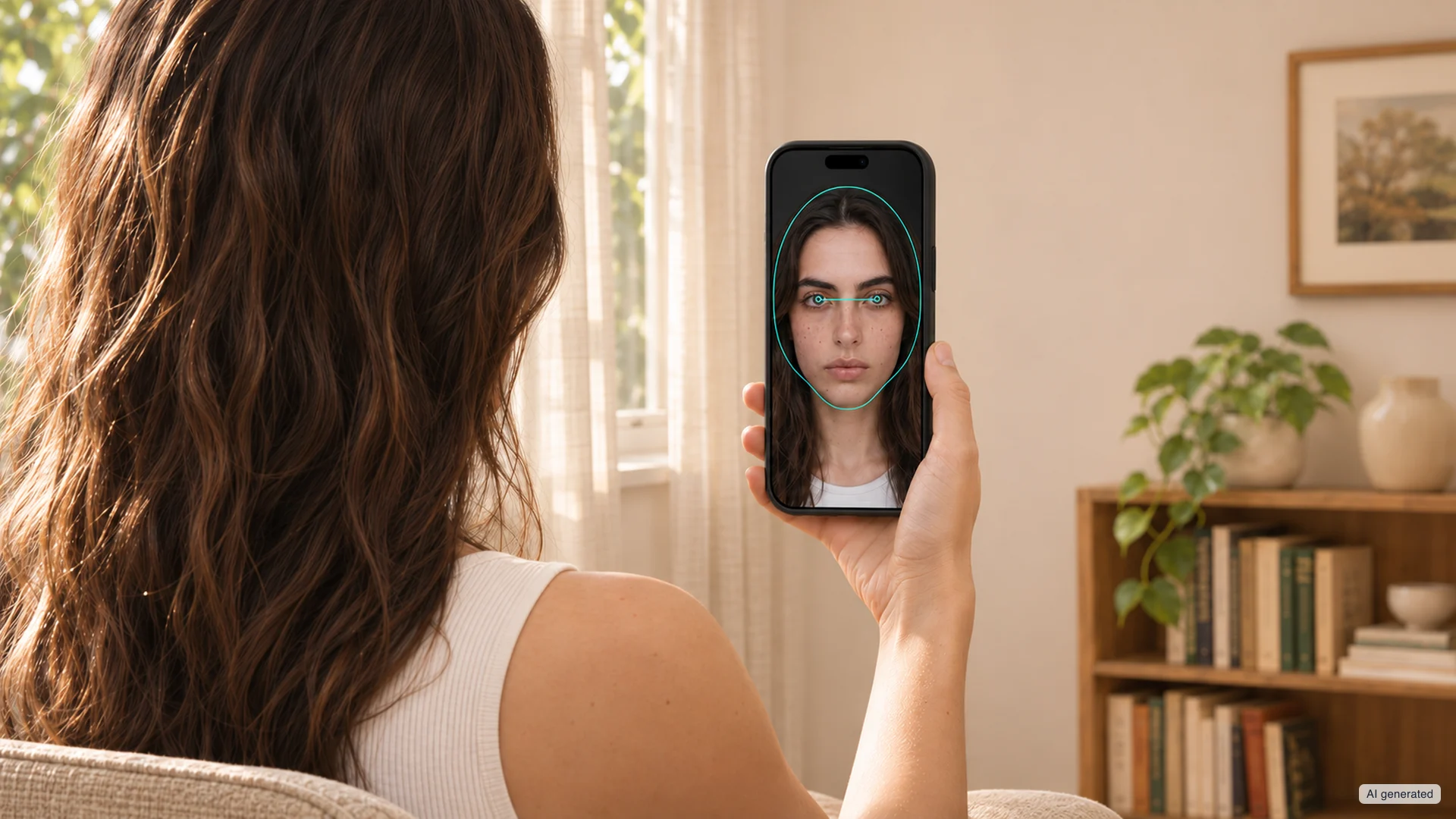
Prescription glasses can be sold online in most of the countries we examined: in some the restrictions are minimal, in others sales are subject to conditions laid down in national legislation; in some they are still prohibited. Where they can be sold online, one important piece of information is usually missing, and it does not always appear on the prescription: pupillary distance (PD). Without it, a customer might put off buying. Today it can be measured with a phone, or with any other device that has a camera and a browser, with an accuracy similar to that of professional instruments. For low and moderate prescriptions, the difference falls within the margin the standards allow for the finished glasses; for high prescriptions and varifocal (progressive) lenses, measurement by a professional remains preferable.
Where can you sell prescription glasses online?
In the 28 countries we examined, selling prescription glasses online is explicitly prohibited in only two: in the others it is unrestricted or permitted subject to conditions, or it takes place even though the rules do not explicitly set out the conditions for it. Our aim was to establish the rules in the main countries and so give as complete a picture as possible of the prospects for selling worldwide.
Naturally, we looked at the rules governing online sales of glasses with prescription lenses. Contact lenses and ready-made reading glasses follow different rules. There is no official table, European or international: the picture that follows has been pieced together from legislation, court rulings and public documents. It does not claim to be exhaustive, only to offer a starting point for looking further into individual countries.
The countries examined fall into five groups. Countries where online sales are:
- Permitted (eight countries): no particular prohibitions came to light; at most, a valid prescription is needed.
- Permitted, with conditions (seven): the law sets out the conditions under which it can be done, such as a prescription, a qualified professional, the customer’s age or the type of lens.
- Permitted, but with a regulatory gap (three): sales are restricted to a professional; online sales are not mentioned, or are disputed.
- Explicitly prohibited (two): the ban is set out in the rules.
- Probably permitted, not officially confirmed (six): public sources point in one direction, but we have not traced the legislation behind it or a court decision that states it officially.
In federal countries, or those with autonomous regions, the relevant rules may vary by state, region or province. Canada and Belgium are examples: the rules change from one province or region to the next.
Where it is permitted. In the United States there is no federal ban: the federal rule requires whoever carries out the eye examination to give the customer the prescription.1 California and Kentucky require sellers based in another state to register;23 in 2026 California penalised those that had not.4 In Germany glasses are not among the devices that require a prescription and, as far as we are aware, the legislation does not regulate distance selling;5 anyone who makes and fits glasses at premises in Germany must, however, be a registered craft business.6 In Japan prescription lenses fall into the lowest class of medical devices, which can be sold without authorisation or notification.7
Where it is permitted, with conditions. In France, the legislation provides for online sales: they require a qualified optician, a valid prescription and a website that meets specific requirements.8 In the United Kingdom a 1984 Order allows them for customers aged 16 or over, with a prescription no more than two years old.9 In Spain the rule is the strictest of the group: the first pair must be fitted at an authorised optician’s, and only a repeat of a pair already made is allowed online.1011
Where the rule is unclear. In Italy the sale to the public of glasses with made-to-measure lenses is restricted to the optician, who must handle it “directly or under their direct supervision”.12 In 2008 the Ministry of Health, responding to a complaint, judged online sales to be contrary to these rules.13 No provision expressly prohibits them, however, and no court rulings have come to light. In practice some businesses deliver to customers’ homes, while several chains take the order online and hand the glasses over in the shop.
Where it is not permitted. In South Korea the law has banned online and other distance sales of corrective glasses since 2012.14 In Turkey the medical devices regulation and the regulator’s guideline prohibit the online sale to consumers of prescription lenses and of the frames made for them.15
Where pupillary distance comes in. Few rules mention it. In France it must be written on the medical prescription, and the law allows the optician’s measurements to be taken remotely.8 In December 2024 the Paris Court of Appeal found the online measurements examined in one case “suffisamment précises” (sufficiently precise).16 In the United States the federal rule does not make it a mandatory item on the prescription.17 In most of the countries examined no provision says who must measure it: that does not mean a measurement taken by the customer is recognised, only that the law is silent on it.
| Country | Online sales | In brief |
|---|---|---|
| United States | Permitted | No federal ban; the prescription must be given to the customer.1 |
| United States: California, Kentucky | Permitted, with conditions | Sellers based in another state must register.23 |
| Germany | Permitted | No law on distance selling, no prescription requirement.5 |
| Japan | Permitted | Lenses in the lowest class of medical devices.7 |
| Portugal | Permitted | No channel is prohibited; prescription and qualified technician.18 |
| Netherlands | Permitted | The sale of glasses is not a restricted activity.19 |
| Poland | Permitted | Only off-premises sales are prohibited.20 |
| Sweden | Permitted | Under the age of 8, a doctor’s instruction is needed.21 |
| Australia | Permitted | Only prescribing is restricted.22 |
| Australia: South Australia | Permitted, with conditions | A valid prescription is required by law.23 |
| Canada: British Columbia | Permitted | With a copy of the prescription or with details stated by the customer.24 |
| Belgium: Flanders | Permitted | The optician’s trade is not regulated.25 |
| France | Permitted, with conditions | Qualified optician, valid prescription, website meeting specific requirements.8 |
| United Kingdom | Permitted, with conditions | Customers aged 16 or over; prescription no more than two years old.9 |
| Spain | Permitted, with conditions | First pair in an authorised shop; online, repeat pairs only.10 |
| Singapore | Permitted, with conditions | Single-vision lenses only, from age 16, with pupillary distance on the prescription.26 |
| Ireland | Permitted, with conditions | Sale conducted by a registered professional, on prescription.27 |
| Austria | Permitted, with conditions | Professional licence for those selling from Austria.28 |
| Hungary | Permitted, with conditions | Home delivery allowed, provided fitting and instructions are guaranteed.29 |
| Canada: Ontario, Quebec | Permitted, with conditions | Remote delivery, on specific conditions.3031 |
| Belgium: Brussels, Wallonia | Permitted, with conditions | A professionally qualified manager is required.32 |
| Italy | Permitted, but with a regulatory gap | Sale restricted to the optician; online sales are not mentioned.12 |
| Brazil | Permitted, but with a regulatory gap | Sale in authorised shops, with a prescription; nothing on online sales.33 |
| Malaysia | Permitted, but with a regulatory gap | Sale restricted to professionals; online, repeat purchases only.3435 |
| South Korea | Explicitly prohibited | Banned by law since 2012.14 |
| Turkey | Explicitly prohibited | Ban in the regulation and in the regulator’s guideline.15 |
| Norway | Probably permitted, not officially confirmed | Likely status: permitted.36 |
| Switzerland | Probably permitted, not officially confirmed | Likely status: permitted. Professional authorisation in Basel-Stadt and Zurich.37 |
| China | Probably permitted, not officially confirmed | Likely status: permitted.38 |
| India | Probably permitted, not officially confirmed | Likely status: permitted.39 |
| Denmark | Probably permitted, not officially confirmed | Likely status: permitted, with conditions.40 |
| Greece | Probably permitted, not officially confirmed | Likely status: permitted, but with a regulatory gap.41 |
| Canada: Alberta, Manitoba | Probably permitted, not officially confirmed | No specific rules on online sales came to light.42 |
The position as at 23 November 2026, compiled from legislation, court rulings and public documents. It is not legal advice. Rules change, may vary by region or state, and may depend on the customer’s age and the type of lens. Before selling in a country, check with a lawyer or the relevant authority there.
Who buys prescription glasses online, and why?
Only a minority of customers buy prescription glasses online today, drawn by price, choice and convenience,43 but where the rules allow it, the online share is growing. In the United States the proportion of glasses bought online rose from 13% to 16% between the second quarter of 2025 and the second quarter of 2026.44 In the United Kingdom, 6% of people who bought glasses after a sight test bought them online.45 In Germany, 2.3% of the glasses sold in 2025 were sold online.46
One figure is more encouraging still: people who buy online are more likely to buy more than one pair, 53% compared with 36% of those who buy in a shop.47 They are also more inclined to recommend the retailer.48 The reasons they give are price, choice and convenience.49 To place an order, customers supply their own pupillary distance.50 A system that lets them measure it quickly, in a few steps, helps the purchase along.
In short, the shop still takes centre stage, but online growth is also benefiting from remote measurement, which is becoming ever simpler and more familiar. Sight tests with the optometrist joining by video link, for example, are increasingly common, for now mostly inside shops.5152 Many online retailers already let customers upload the prescription from their eye examination and measure their pupillary distance with their own device; others offer a remote appointment with a professional, who uses the tools on the customer’s phone. It is reasonable to expect that increasingly automated and reliable systems will soon be able to support human involvement, if not replace it altogether, and make buying prescription lenses online a very attractive option. Those who gear up now will be ready.
Why does pupillary distance matter, and how accurate does it need to be?
Pupillary distance is used to place the centre of each lens in front of the pupil, and the accuracy required depends on the prescription: a few millimetres matter little with low-powered lenses and a great deal with high-powered ones.
Pupillary distance is the distance between the centres of the pupils, in millimetres.5354 It is given as a single total value or as two values, one for each eye, which are not necessarily the same.55
If the centre of the lens is not where it is meant to be, the lens bends light like a prism. The effect grows with the offset and with the power of the lens: this is Prentice’s rule.56
The standards set the margin for the finished glasses, not for the measurement. The American standard ANSI Z80.1 and the international standard ISO 21987 allow a horizontal imbalance of 0.67 prism dioptres; for higher prescriptions, above about 3 dioptres, the limit becomes an offset of 2.5 mm in the former and 2 mm in the latter.575859 Converted into millimetres using Prentice’s rule, that limit comes to about 6.7 mm for a 1-dioptre lens, 3.3 mm at 2 dioptres and 2.2 mm at 3 dioptres.
Even professional measurements do not agree with one another. In a study of 199 people, ruler and pupillometer gave results within 2 mm of each other in 77% of cases.60 In a 2026 study, two professional instruments differed by more than 2.5 mm in 12.5% of cases.61 A difference of 2 or 3 mm, then, is not unique to the phone.
Part of the difference comes not from the instrument but from how the measurement is taken. Two professional measurements of the same person can differ by 1 or 2 mm even with the same instrument.60 If the person looks at something near rather than far away, the distance shrinks by 3 or 4 mm.6062 The size of the pupil, which changes with the light, shifts its centre by only a few tenths of a millimetre.63
Pupillary distance alone is not always enough. Varifocal lenses also need the distance for each eye and the heights, taken with the frame on;55 above 4 dioptres the distance between lens and eye matters too.54 In these cases, and for minors, measurement by a professional in person remains preferable.
How reliable is measuring pupillary distance with a phone today?
In the most recent independent studies, phone apps measure pupillary distance with a mean difference of less than a millimetre from professional instruments; for an individual customer the difference normally stays within 2 or 3 mm.
The improvement is marked. In 2012 the first app studied was out by more than 3 mm on average, and the band containing 95% of the differences was almost 13 mm wide.64 In 2023, two apps out of three showed a mean error of 0.5 mm against the pupillometer.65 In 2024 one app gave a mean difference of 0.59 mm, with 95% of the differences between −2.89 and +1.70 mm.66 In 2026, across 90 adults, the mean differences stayed below 0.7 mm.67 Today that band is 3 to 5 mm wide: about a third as wide as in 2012.
That is the same order of magnitude as the gap between two professional instruments. For prescriptions up to about 3 dioptres, a difference of 1 or 2 mm falls within the margin the standards allow for the finished glasses. Beyond that, some of the measurements fall outside it.
The limitations of these findings should be stressed, however. The studies are small, with 40–90 adult participants, and were carried out in clinical settings. They do not cover varifocal lenses, minors or the pupillary distance of each eye taken separately.
Quick measurement or measurement with a card?
It pays to offer both: the quick measurement asks less of the customer, the card measurement is more accurate.
In quick mode, the customer looks at the camera and need do nothing else. To get from pixels to millimetres, the system uses a generally accepted reference measurement for the iris.68
In card mode, the customer holds a standard-size card, such as a credit card or a loyalty card, next to their face. Its dimensions are a standard recognised in every country, so it serves as a scale reference: that is why the measurement is more accurate. It does, however, take a few more steps and needs clear guidance. We have found no published independent studies on this method.
Both measurements are also useful in a shop that has neither a professional nor a pupillometer: a department store, for example.
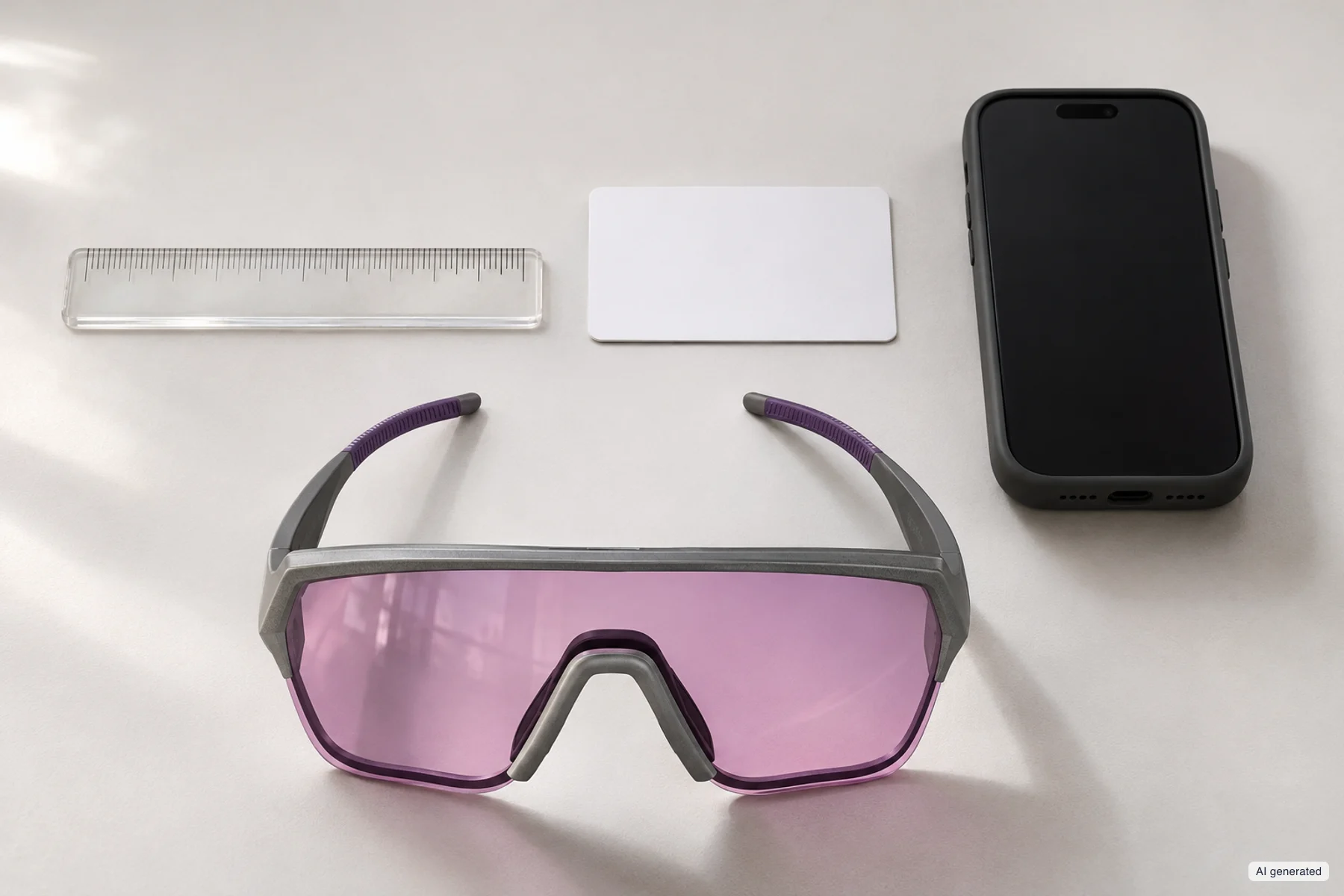
With AR PD Meter, ARShades offers both modes, directly in the browser and with no app to download. The instant measurement has an average error of about 2 mm. The card-verified measurement, guided by on-screen and voice prompts, has an average error of about 1 mm.69
AR PD Meter is also among the most secure on the market: the card number is anonymised and is not read. Images and video from the camera do not leave the device; only geometric points of the face are used for the calculation, and these are not stored. The measured value goes straight into the order, with no need to copy it out or pass it on.
AR PD Meter is available on its own or together with Virtual Try-On on the Smart plan, as part of an Enterprise project and in the ARShades VTO app for Shopify. Find out more on the AR PD Meter page.
Beyond lenses: what is a good pupillary distance measurement used for?
A correctly measured pupillary distance does more than support people buying prescription lenses: it allows many other measurements to be derived, in other fields too. Put simply, it can also act as a ruler, showing how many millimetres a pixel in the photo corresponds to.
From there, other measurements of the face can be worked out and, with several images, of the head. The principle is documented: in a 2023 study of 344 frontal photos, using the iris as a ruler, the facial measurements differed on average by 2.9 mm from those taken with callipers.68 Measuring the person’s own pupillary distance avoids having to assume an average iris.
It is already used today to adjust Virtual Try-On and to choose the frame size. When choosing a frame, pupillary distance is compared with the distance between the centres of the two lenses.70 Made-to-measure glasses start from a set of facial measurements, including the distance between the eyes.71
What is more, in professional systems it helps to establish a customer’s measurements online from a photo, in millimetres and with a small margin of error, in order to personalise glasses, goggles, helmets and, potentially, any product that comes in sizes. The level of confidence depends on the quality of the starting measurement, which is why it is essential to rely on professional solutions, such as those ARShades can offer.
Frequently asked questions
In which countries can you sell prescription glasses online?
Our review of 28 countries shows that sales are unrestricted in eight, including the United States, Germany and Japan, and permitted subject to conditions set by legislation in seven, including France, the United Kingdom and Spain. They are prohibited in only two countries: South Korea and Turkey. In some cases, as in Italy, the legislation does not regulate the online market in detail.
Does pupillary distance have to be written on the prescription?
It depends on the country. In France and Singapore it must be;826 in the United States the federal rule does not make it mandatory.17 In most of the countries examined, no provision directly governs who should measure it.
Is pupillary distance measured with a phone as accurate as a professional measurement?
On average, yes: in the independent studies of 2023–2026 the mean difference from professional instruments, which cost far more, is under one millimetre.656667 For an individual customer the difference normally stays within 2 or 3 mm, the same order of magnitude that separates two different professional instruments.60 The studies are small and involve adults.
Is a 2 mm error in pupillary distance acceptable?
It depends on the prescription strength. The standards for finished glasses allow an offset of more than 3 mm for a 2-dioptre lens and of about 2 mm above 3 dioptres.5758 The stronger the lens, the tighter the margin.
Is pupillary distance enough for varifocal lenses?
No. You also need the distance for each eye, measured separately, and the heights, taken with the frame on.55 For these lenses, measurement by a professional remains preferable.
What is pupillary distance used for, apart from lenses?
It is used to adjust Virtual Try-On and to choose the frame size.70 A reliable measurement also gives the scale of the face in a photo: it converts pixels into millimetres. It can be used in the online personalisation of glasses and other products.
Is measuring with AR PD Meter safe for the customer’s data?
Yes. AR PD Meter is among the most secure on the market: the card number is anonymised and is not read. Images and video from the camera do not leave the device; only geometric points of the face are used for the calculation, and these are not stored.
Sources
-
Federal Trade Commission, “Ophthalmic Practice Rules (Eyeglass Rule)”, 16 CFR Part 456, text in force following the amendment of 26 July 2024. https://www.ecfr.gov/current/title-16/part-456 ↩ ↩2
-
State of California, Business and Professions Code, §§ 2564.70–2564.80 (Nonresident Ophthalmic Lens Dispenser Registration Act), text in force from 1 January 2026. https://leginfo.legislature.ca.gov/faces/codes_displayText.xhtml?lawCode=BPC&division=2.&title=&part=&chapter=5.5.&article=2.5. ↩ ↩2
-
State of Kentucky, Kentucky Revised Statutes, § 367.686, in force from 14 July 2018. https://statecodesfiles.justia.com/kentucky/2022/chapter-367/section-367-686/section-367-686.pdf ↩ ↩2
-
California State Board of Optometry, “2026 Citations & Disciplinary Actions”, 2026. https://www.optometry.ca.gov/consumers/2026_disciplinary.html ↩
-
Federal Republic of Germany, “Verordnung zur Regelung der Abgabe von Medizinprodukten (MPAV)”, Annex 1, current text. https://www.gesetze-im-internet.de/mpav/BJNR122710014.html ↩ ↩2
-
Federal Republic of Germany, “Gesetz zur Ordnung des Handwerks (Handwerksordnung)”, § 1 and Annex A no. 33, current text. The requirement concerns those who make and fit glasses at premises in Germany, not the sales channel. https://www.gesetze-im-internet.de/hwo/__1.html ↩
-
Japan, Act on the quality, efficacy and safety of pharmaceuticals and medical devices (Act No. 145 of 1960), arts 39 and 39-3, text in force in 2026. https://laws.e-gov.go.jp/law/335AC0000000145 ↩ ↩2
-
French Republic, “Code de la santé publique”, articles L.4134-1, L.4362-9, L.4362-10, L.4362-10-1, R.4362-14, R.4362-15 and D.4362-20, text in force in November 2026. https://www.legifrance.gouv.fr/codes/texte_lc/LEGITEXT000006072665/ ↩ ↩2 ↩3 ↩4
-
United Kingdom, “The Sale of Optical Appliances Order of Council 1984” (S.I. 1984/1778), under the Opticians Act 1989, s. 27. The conditions apply to those who sell without the supervision of a registered professional. https://www.legislation.gov.uk/uksi/1984/1778/pdfs/uksi_19841778_en.pdf ↩ ↩2
-
Kingdom of Spain, “Real Decreto 192/2023, por el que se regulan los productos sanitarios”, art. 24.5, 21 March 2023. https://www.boe.es/buscar/act.php?id=BOE-A-2023-7416 ↩ ↩2
-
Tribunal Supremo, Sala de lo Contencioso, judgment 206/2017, 8 February 2017. The boundary between a first pair and a remake does not appear to have been defined by recent court decisions. https://www.poderjudicial.es/search/AN/openDocument/a8ef654bfff749db/20170228 ↩
-
Ministero della Sanità, decree of 23 July 1998, Gazzetta Ufficiale no. 180 of 4 August 1998. https://www.gazzettaufficiale.it/atto/serie_generale/caricaArticoloDefault/originario?atto.dataPubblicazioneGazzetta=1998-08-04&atto.codiceRedazionale=098A6989&atto.tipoProvvedimento=DECRETO ↩ ↩2
-
Eyewear Intelligence, “Prescription glasses cannot be sold online under Italian law”, 16 December 2008. The Ministry’s position dates from 2008 and is known from secondary sources. https://www.ewintelligence.com/prescription-glasses-cannot-be-sold-online-under-italian-law-after-/26507.article ↩
-
Republic of Korea, Medical Technicians Act (의료기사 등에 관한 법률), art. 12, para. 5, text in force from 11 September 2026. The review did not cover purchases from foreign sellers. https://www.law.go.kr/법령/의료기사등에관한법률 ↩ ↩2
-
Türkiye İlaç ve Tıbbi Cihaz Kurumu (TİTCK), guideline on the sale, advertising and promotion of medical devices, revision 2, art. 16(11), in force from 9 January 2024. The review did not cover purchases from foreign sellers. https://titck.gov.tr/storage/Archive/2024/contentFile/TCS-KLVZ08%20Sat%C4%B1%C5%9F%20Reklam%20Tan%C4%B1t%C4%B1m%2010.01.24_06a0c733-1257-4f7d-ba48-50201538bef6.pdf ↩ ↩2
-
Cour d'appel de Paris, decision of 12 December 2024 on the appeal against decision 22-D-16 of the Autorité de la concurrence, publishable version. https://www.cours-appel.justice.fr/sites/default/files/2024-12/Essilor%20version%20publiable.pdf ↩
-
Federal Trade Commission, “Ophthalmic Practice Rules (Eyeglass Rule)”, final rule, Federal Register vol. 89, p. 60742, 26 July 2024. Some states require pupillary distance on the prescription. https://www.govinfo.gov/content/pkg/FR-2024-07-26/html/2024-15620.htm ↩ ↩2
-
Portuguese Republic, “Decreto-Lei n.º 29/2024”, arts 24, 26, 44 and 45, consolidated version of 13 November 2025. https://diariodarepublica.pt/dr/legislacao-consolidada/decreto-lei/2024-900839570 ↩
-
Kingdom of the Netherlands, “Besluit opleidingseisen en deskundigheidsgebied optometrist”, Staatsblad 2000, 297, 4 July 2000. https://zoek.officielebekendmakingen.nl/stb-2000-297.pdf ↩
-
Republic of Poland, “Ustawa o wyrobach medycznych”, art. 16, consolidated text Dz.U. 2024 poz. 1620. https://api.sejm.gov.pl/eli/acts/DU/2024/1620/text.html ↩
-
Socialstyrelsen, “HSLF-FS 2023:31”, 27 June 2023, in force from 1 January 2024. https://www.socialstyrelsen.se/contentassets/7d505a6b1d7f4cf79b930848e27a5b44/2023-8-8603.pdf ↩
-
State of Queensland, “Health Practitioner Regulation National Law”, s. 122, text as at 10 April 2026. https://www.legislation.qld.gov.au/view/pdf/inforce/current/act-2009-045 ↩
-
State of South Australia, “Health Practitioner Regulation National Law (South Australia) Act 2010”, ss. 73–76, version of 1 July 2026. https://www.legislation.sa.gov.au/_legislation-documents/lz/c/a/health-practitioner-regulation-national-law-south-australia-act-2010/current/2010.5.auth.pdf ↩
-
Province of British Columbia, B.C. Reg. 129/2025, s. 17, in force from 1 April 2026. https://free.bcpublications.ca/civix/document/id/complete/statreg/129_2025 ↩
-
Government of Flanders, “Een ander gezondheidszorgberoep uitoefenen”, accessed 23 November 2026. https://www.vlaanderen.be/werken/werken-in-de-zorgsector/een-beroep-in-de-gezondheidszorg-uitoefenen/een-ander-gezondheidszorgberoep-uitoefenen ↩
-
Optometrists and Opticians Board, Singapore, “Practice Guidelines for Online Sales of Spectacles”, April 2016 version. https://isomer-user-content.by.gov.sg/82/7b7a9761-b0c2-4a0d-b73c-6e3bf55bac41/annex-1---online-sale-of-spectacles-guidelines-final.pdf ↩ ↩2
-
Ireland, “Optical Registration Board Sale of Spectacles Bye-Law 2018”, S.I. No. 80/2018, 14 March 2018. https://www.irishstatutebook.ie/eli/2018/si/80/made/en/print ↩
-
Republic of Austria, “Gewerbeordnung 1994”, § 98, current text. https://www.ris.bka.gv.at/eli/bgbl/1994/194/P98/NOR40032605 ↩
-
Hungary, Decree 7/2004 (XI. 23.) EüM of the Minister of Health, § 4, para. 5, current text. https://njt.jog.gov.hu/jogszabaly/2004-7-20-0B ↩
-
College of Optometrists of Ontario, “Spectacle Therapy Using the Internet”, November 2025. https://collegeoptom.on.ca/resource/spectacle-therapy-using-the-internet/ ↩
-
Ordre des optométristes du Québec, “Lignes directrices — Téléoptométrie”, revision of 23 March 2026. https://www.ooq.org/sites/default/files/2026-04/LD-CA-T%C3%A9l%C3%A9optom%C3%A9trie_0.pdf ↩
-
Kingdom of Belgium, “Arrêté royal du 21 décembre 2006 relatif à la compétence professionnelle”, art. 16, Walloon version in force from 17 January 2026. https://wallex.wallonie.be/eli/arrete/2006/12/21/2007022161/2026/01/17 ↩
-
Federative Republic of Brazil, Decreto n.º 20.931 of 11 January 1932, arts 38–41, current text. https://www.planalto.gov.br/ccivil_03/decreto/1930-1949/d20931.htm ↩
-
Malaysia, “Optical Act 1991” (Act 469), s. 36, consolidated text 2026. https://lom.agc.gov.my/ilims/upload/portal/akta/outputaktap/3391612_BI/Act%20469%20%28Online%202026%29.pdf ↩
-
Malaysian Optical Council, “Guidelines for Online Sale”, published in June 2025. https://hq.moh.gov.my/moc/wp-content/uploads/2025/06/GUIDELINES-FOR-ONLINE-SALE.pdf ↩
-
Kingdom of Norway, “Lov om helsepersonell (helsepersonelloven)”, text in force in 2026. Our review of the rules on health personnel and medical devices found nothing to prevent online sales. It cannot be ruled out that specific restrictions are laid down in implementing regulations or in other non-public sources. https://lovdata.no/dokument/NL/lov/1999-07-02-64 ↩
-
Swiss Confederation, “Medizinprodukteverordnung (MepV)”, RS 812.213, art. 7; Canton of Basel-Stadt, “Bewilligungen Augenoptik”. At federal level, nothing was found to prevent online sales. The practice of optics is regulated by the cantons: Basel-Stadt and Zurich require a professional authorisation. It cannot be ruled out that other cantons set conditions of their own. https://www.bs.ch/ls/node/30375 ↩
-
People’s Republic of China, E-Commerce Law of 31 August 2018, arts 12–13, in force from 1 January 2019. Online sales are widespread and our review found nothing to prevent them. The general rules on e-commerce, the metrology rules and the national standard on assembled glasses, in force since March 2026, apply. It cannot be ruled out that further requirements arise from product classification or from local licences. https://www.samr.gov.cn/zw/zfxxgk/fdzdgknr/fgs/art/2023/art_14453aa523094819aa8f1d4530ce3cc4.html ↩
-
Republic of India, “Consumer Protection (E-Commerce) Rules, 2020”. Our review found nothing to prevent online sales, and no specific rules on the sale of glasses. Lenses, frames and corrective glasses fall into the lowest risk class of medical devices. It cannot be ruled out that restrictions exist in local regulations or in other non-public sources. https://consumeraffairs.gov.in/public/upload/files/E%20commerce%20rules_1732703966.pdf ↩
-
Kingdom of Denmark, “Autorisationsloven”, consolidated text LBK no. 1008 of 29 August 2024, § 67. Under the Act, only authorised opticians may carry out the activity that includes fitting, checking and supplying glasses; under the age of 10, the first supply requires a medical examination. Our review found no specific rules on online sales; public sources do not make clear whether the reservation extends to remote delivery. https://www.retsinformation.dk/eli/lta/2024/1008/pdf ↩
-
Hellenic Republic, Law 5161/2024, art. 39, amending Law 971/1979, 29 November 2024. Sales are permitted in optical shops and in other outlets with a responsible optician, on an ophthalmologist’s prescription. The law does not expressly regulate online sales and no public decisions on the point have come to light; trade associations dispute their lawfulness for unlicensed websites. https://www.taxheaven.gr/law/5161/2024/arthro/39 ↩
-
Province of Alberta, “Health Professions Act”, ss. 1.2 and 1.3, text as at 31 July 2026. Our review found nothing to prevent online sales, and no specific rules on them, in Alberta and Manitoba. https://kings-printer.alberta.ca/documents/Acts/H07.pdf ↩
-
The Vision Council, “Market inSights 2025”, press release, 27 January 2026. https://thevisioncouncil.org/sites/default/files/assets/images/research/Market%20inSights%202025%20Press%20Release%201.27.26.pdf ↩
-
Eyecare Business, “Midyear 2026 optical consumer snapshot”, 17 August 2026. https://eyecarebusiness.com/issues/2026/business-intel/midyear-2026-optical-consumer-snapshot/ ↩
-
General Optical Council and DJS Research, “Public perceptions research 2026”, 30 June 2026. https://optical.org/asset/A8951D0F%2DC036%2D4FA0%2D919732474B842908/ ↩
-
Zentralverband der Augenoptiker und Optometristen (ZVA), “Branchenbericht Augenoptik 2025/2026”, 28 April 2026. https://www.zva.de/wp-content/uploads/ZVA-Branchenbericht-2025-Download.pdf ↩
-
Optometry Times, “Consumer eyewear spending holds steady in Vision Council Q3 report”, 9 November 2026. https://www.optometrytimes.com/view/consumer-eyewear-spending-holds-steady-in-vision-council-q3-report ↩
-
The Vision Council, “Focused inSights 2024: Shopping Habits”, press release, 12 March 2024. https://thevisioncouncil.org/sites/default/files/assets/media/TVC_Focused%20Insights%20Shopping%20Habits%20Press%20Release.pdf ↩
-
The Vision Council, “Focused inSights 2024: Consumer Choices”, press release, 22 November 2024. https://thevisioncouncil.org/sites/default/files/assets/media/TVC_Focused%20Insights%20Consumer%20Choices%20Release.pdf ↩
-
The College of Optometrists, “Buying spectacles online”, position statement, May 2017. https://www.college-optometrists.org/policy-and-influencing/position-statements/buying-spectacles-online ↩
-
Lenskart Solutions Ltd, transcript of the investor call of 4 November 2026, filed on 10 November 2026. https://nsearchives.nseindia.com/corporate/LENSKART_10112026200204_Reg30_-_Transcript_-_SE_Intimation_signed.pdf ↩
-
National Vision Holdings, annual report (Form 10-K) for fiscal year 2025, 4 March 2026. https://www.sec.gov/Archives/edgar/data/1710155/000162828026014379/eye-20260103.htm ↩
-
Canadian Association of Optometrists, “Interpupillary Distance (PD)”, updated 18 March 2023. https://www.opto.ca/eye-health-library/interpupillary-distance-pd ↩
-
World Health Organization, “Summary guide on quality standards for spectacles”, 23 May 2025. https://iris.who.int/bitstream/handle/10665/381356/9789240109483-eng.pdf?sequence=9 ↩ ↩2
-
Cheryl Hill, Association of British Dispensing Opticians, “A review of spectacle lens dispensing measurements”, July–August 2024. https://www.abdo.org.uk/wp-content/uploads/2024/06/DO-July-_-August-2024-CPD-with-References.pdf ↩ ↩2 ↩3
-
Diane F. Drake, National Academy of Opticianry, “Prentice’s Rule and Finding the Power of a Lens in Any Meridian”, 2018. https://www.nao.org/wp-content/uploads/2020/12/Prentices-Rule.pdf ↩
-
The Vision Council, “Dispensing Guide”, 2020, with the quick reference guide to the ANSI Z80.1-2015 standard. The current edition of the standard is Z80.1-2025. https://thevisioncouncil.org/sites/default/files/assets/media/Dispensing-Guide_2020.pdf ↩ ↩2
-
Optics and Radiometry Laboratory, University of New South Wales, technical note no. 6, with the table from the AS/NZS ISO 21987:2011 standard. The current edition of the standard is ISO 21987:2017. https://www.optometry.unsw.edu.au/sites/default/files/documents/orlab_tech_note_6.pdf ↩ ↩2
-
International Organization for Standardization, “ISO/TR 11797:2024 — Ophthalmic optics — Spectacle lenses — Power and prism measurements”, November 2024. https://www.iso.org/standard/83918.html ↩
-
Liat Gantz, Einat Shneor and Ravid Doron, “Agreement and inter-session repeatability of manual and automatic interpupillary distance measurements”, Journal of Optometry, October–December 2021. https://pmc.ncbi.nlm.nih.gov/articles/PMC8569403/ ↩ ↩2 ↩3 ↩4
-
Mansour A. Alghamdi, “Can Autorefractometer and Digital Pupillometer Readings of Interpupillary Distance Be Used Interchangeably?: A Cross-Sectional Study”, Life, 5 November 2026. https://doi.org/10.3390/life16111871 ↩
-
Saud A. AlAnazi, Mana A. AlAnazi and Uchechukwu L. Osuagwu, “Influence of age on measured anatomical and physiological interpupillary distance (far and near), and near heterophoria, in Arab males”, Clinical Ophthalmology, April 2013. https://doi.org/10.2147/OPTH.S43626 ↩
-
Yabo Yang, Keith Thompson and Stephen A. Burns, “Pupil location under mesopic, photopic, and pharmacologically dilated conditions”, Investigative Ophthalmology & Visual Science, July 2002. https://pmc.ncbi.nlm.nih.gov/articles/PMC2989408/ ↩
-
Timothy T. McMahon, Elizabeth L. Irving and Claudia Lee, “Accuracy and repeatability of self-measurement of interpupillary distance”, Optometry and Vision Science, June 2012. https://pubmed.ncbi.nlm.nih.gov/22581116/ ↩
-
Kenneth D. Han et al., “Comparing the Effectiveness of Smartphone Applications in the Measurement of Interpupillary Distance”, Cureus, 31 July 2023. https://pmc.ncbi.nlm.nih.gov/articles/PMC10389117/ ↩ ↩2
-
Yee Rin Jung and Byoung Sun Chu, “A Comparative Analysis of Interpupillary Distance Measurement Techniques Evaluation in Modern Times: From Rulers to Apps”, Clinical Optometry, 14 December 2024. https://pmc.ncbi.nlm.nih.gov/articles/PMC11654209/ ↩ ↩2
-
Sara Farsi, Tahereh Rakhshandadi, Amirreza Entezari and Monireh Mahjoob, “Evaluation of agreement among four different methods for measuring inter-pupillary distance in healthy adults”, Reviews in Clinical Medicine, 1 June 2026. https://rcm.mums.ac.ir/article_28005.html ↩ ↩2
-
Zeynab Pirayesh et al., “A deep learning framework to scale linear facial measurements to actual size using horizontal visible iris diameter: a study on an Iranian population”, Scientific Reports, 23 August 2023. https://doi.org/10.1038/s41598-023-40839-6 ↩ ↩2
-
Indicative values, from ARShades internal tests. ↩
-
ABDO College, “ABDO Frame Ruler”, user manual, 2019. https://abdocollege.org.uk/wp-content/uploads/2023/01/Cropped-ABDO-Frame-Ruler-24pp-AW.pdf ↩ ↩2
-
Cubitts, “Made to Measure and Bespoke”, accessed 23 November 2026. https://cubitts.com/pages/made-to-measure-and-bespoke ↩
Share
Send this article to a colleague or save the link.
Related insights
View all articlesVirtual try-on for eyewear: from experiment to sales tool
In just a few years, virtual try-on for eyewear has gone from an experiment, almost a party trick, to a promising demo, and is now an established feature of product pages. What has changed in the technology, who is already using it, and where brands, manufacturers and shops stand today.
18 min read
Adoption and resultsDesigning a Virtual Try-On pilot that supports a decision
Test scope, quality criteria, audience assignment and uncertainty in the results. How to build evidence that helps you decide whether, and on what terms, to extend Virtual Try-On.
8 min read
Virtual Try-OnVirtual try-on for eyewear in 2026: what has changed and what to ask a provider
Proportions, realistic lenses, privacy and PD estimates in the browser: the criteria to check during a demo.
10 min read